After 6 months of overtime and long road trips for work (secret government hush hush stuff), it was finally time to travel and play. My wife Corina and I planned a over month long road trip from the northern tip to the southern tip. It was amazing. Soaking in secluded hot springs, climbing glaciers, eating huhu grubs at the wild foods festival, picking grapes on a vineyard, fishing for snapper, hiking the Milford Track...it seemed to never end.
Though my job contract didn't leave much time for being creative, I was able to smoke some great Havana products after work. But after 6 months of not having an outlet for my artistic side, I was ready to explode.
Luckily our road trip went through a little town called Hokitika on the West Coast of the South Island. Hokitika is in an area known for its greenstone (Pounamu). This stone is usually carved into intricate native designs that have deep spiritual meanings. Historically, the stone was painstakingly carved by hand using sandstone. The pieces were prized and passed down for generations. We had heard about Bonz 'n Stonz, a shop in Hokitika where they teach you to carve your own pounamu. This was my chance to create.
Corina arrived at the shop at the crack of dawn with our greenstone designs in mind. My design was Hei Tiki, seen as either a memorial to ancestors or the goddess of childbirth. The tiki is used to promote fertility and is much more intricate in design than other Maori (NZ native) designs like the fish hook, twists and spirals. The tikis are meant to be unique, and are adapted to represent your ancestry and local culture. I gave mine a spiked head to represent the mountains of Asheville, my home. My tiki was also holding three cigars. One for me, one for Corina, and one for my friends and family.

The owner of the shop, Steve Gwaliasi, is a master of pounamu carving and was our guide for the day. He's a great teacher, mastering the art of helping without intimidating. I was having trouble picking a piece of greenstone from the pile that was worthy of the design and had the weight and girth needed for such a piece. When he saw the design I had drawn out as my template, he claimed "Oh, you serious!" He then showed me his secret stash of pounamu that he keeps for his own pieces. I took out a great slab of rich green stone that had few inclusions.

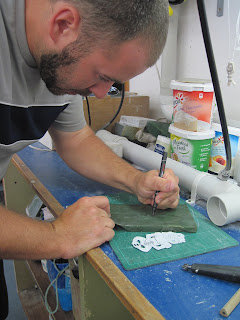 Steve cut a chunk off the slab and let me do the rest. Considering the value of such a large quality slab, I was happy for him to make the first cut. The slab had a hefty price written on it, which Steve politely disregarded, as he was happy to give me material suitable for my design (phew!).
The first step was grinding out the basic outline of the piece before creating any depth. The diamond wheels Steve had in the shop cut through the stone like butter. Quite impressive considering the strength of the stone. Pounamu was partially prized for its strength, as the stone is composed of interwoven fibers. The native Maori used the stone for adzes, chisels, used to cut through the native hardwoods. After much of the greenstone had been cultivated, many of these adzes were then reclaimed and cut into tikis, since the adze shape could easily be remade into a tiki.

The main design finally took shape and it was time to create some depth to the piece. Using the same wheels, I cut out some of the negative space to make the detail work a bit easier.

In order to keep the stone from chipping and the diamond bits from wearing out, a constant stream of water needs to be run over the carving. This makes the carving a bit more difficult as the ripple of the water obscures the area being carved.


I added a tattoo converse to the shoulder to give the piece a bit more character. It was also meant to give homage to the native art of moko, the tattooing art of the native. This tattooing is done by hand and consists of carving a design into the skin over days or even weeks. I was hoping to get one while I was there, but decided to stick with my tiki. Maybe when I return someday.


A light application of oil smoothed over some of the imperfections and gave it a nice glow. The piece was finally finished.

Corina and I posed with Steve, our carving mentor, after we finished our pieces. I was shocked at the weight of it. Tikis are usually worn around the neck, but are probably reserved for special occasions as they are quite heavy!

As we drove back to Auckland, I took the opportunity for a little tiki photo shoot with Lake Tekapo. The milky blue water and the surrounding moutains was a great backdrop for tiki. The carver in me was finally let back out!


